Teach social problem solving (Early Childhood)
teaching practiceFor student year
Helps students to
- solve social problems
- become independent
Helps teachers to
- support social development
- model strategies
Summary
Social problem solving is a skill that develops during the early years of school. It is the process used to analyse, understand, and respond to everyday problems, decision making, and conflicts.
Social problem solving is often fostered intuitively through interactions with others. Some young learners, including those on the autism spectrum, may benefit from systematic instruction for social problem solving.
Social problems can be as simple as turn-taking or sharing toys, and as complex as bullying.
Instruction helps children to understand:
- what a social problem is
- how to recognise a social problem
- the process to follow when a social problem occurs, and
- the strategies they could use to solve a social problem.
How this practice works
Watch this video to learn more about this practice.
Duration: 03:49
Australian Children’s Education and Care Quality Authority (ACECQA) National Quality Standards (NQS) related to this practice
Element 5.1.1: Positive educator to child interactions
Responsive and meaningful interactions build trusting relationships which engage and support each child to feel secure, confident and included.
Element 5.2.2: Self-regulation
Each child is supported to regulate their own behaviour, respond appropriately to the behaviour of others and communicate effectively to resolve conflicts.
Early Years Learning Framework outcomes related to this practice
Outcome 1: Children have a strong sense of identity
Outcome 4: Children are confident and involved learners
For further information, see ACEQA’s Approved learning frameworks page
Preparing to teach
Be proactive
- Identify barriers to learning and social demands and put these strategies in place to reduce the likelihood of problems occurring in the first place.
- Use observations to develop a clear and comprehensive understanding of the problem(s) that the learner is experiencing.
- When necessary, seek external specialist assessment and opinion. You can then:
- understand possible triggers
- be alert to any potentially challenging situations throughout the day.
- Identify the specific strategy to teach learners how to find a solution. There are several strategies available in the Resources section below.
- Plan to explicitly and systematically teach the social problem-solving process to learners:
- as a whole class
- in small groups
- individually
- a mix of above.
Use supports
- Identify and develop the visual supports required to explicitly and systematically teach a social problem-solving process and keep these handy. These can be social stories, routine charts, or emotion cards for self-regulation.
- Identify appropriate storybooks and visual supports that you can incorporate in your explicit teaching to enhance learner understanding.
- Incorporate engaging and motivating activities, such as:
- role-play/rehearsal
- puppet play (check the children aren’t frightened of puppets)
- social stories
- visual prompts.
Consider
Consider how you will:
- embed problem solving scenarios
- model the problem-solving process
- positively encourage, support, and reinforce learners to use the process to solve real-life social problems
- share the social problem-solving process with families.
Communicate
Communicating with families will encourage generalisation of the associated strategy at home. You can also communicate the types of language used so families can use similar language at home if they like.
The turtle technique
When you have a clear understanding of the problem the learner is experiencing, you can then identify and use a specific intervention process to teach the learner how to find a solution. One such process is the turtle technique. This involves teaching learners the steps of how to control feelings and calm down by pretending to tuck away in a turtle shell for some deep breaths. Explicitly teaching these strategies in an age-appropriate way helps embed positive self-regulation habits early.
You will find further templates in the resource section of this practice.
It works better if:
- the social problem-solving strategy has a small number of set steps
- educators model these steps
- children are reminded about the strategy in the moment they need support
- children are encouraged to use to the strategy to solve their social problems whenever they occur
- language is used consistently and modelled throughout the day and at home
- visual supports are used to enhance learner understanding of the strategy.
It doesn’t work if:
- the child is expected to solve a social problem when distressed or overloaded
- the child hasn’t understood the problem-solving strategy (so it will need re-teaching)
- the problem-solving strategy has too many steps.
- too many strategies are used at once – choose one to trial before moving on to another if the first one doesn’t work
In the classroom
How do I do it?
Step 1: Teach social problem solving
Explicitly and systematically teach a social problem-solving strategy using visual supports. These are available in the resources section.
Example
You notice learner A becomes frustrated when others don't want to play the same game. You can introduce the concept of turn-taking and establish strategies for the children to determine whose turn it is, promoting fairness and equality. Learner A can then independently use these strategies when this comes up again.
Step 2: Practice relaxation
Ensure your learners practise relaxation skills or are aware of different strategies for when they feel problems arising.
Step 3: Embed and respond
Be alert to any situations throughout the day that may result in social conflict.
Model using the strategy to solve social problems.
Support the child’s use of the strategy in relation to their encountered social problems:
- remain calm – personally model the skills involved
- reduce ‘talk’ and use visual cues
- deal with social conflict in a consistent manner.
Acknowledge and positively reinforce all attempts by the child to use problem-solving skills.
Step 4: Review
Wait until the child is calm and receptive before providing feedback.
Step 5: Reflect
Reflect on whether the child was able to solve the social problem independently, or whether the strategy needs to be adjusted.
Record learner outcomes in order to track progress.
Note program outcomes.
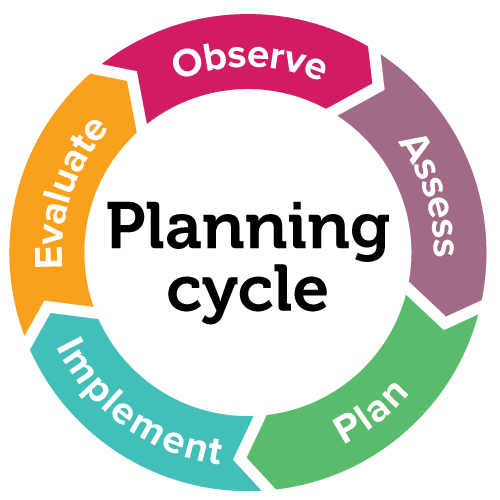
Use EYLF Planning Cycle to teach social problem-solving
- Observe: which learners need additional support in managing social conflict or which activities tend to create social conflict
- Assess: which strategy you will use and the learner’s current social and emotional development
- Plan: how you will introduce the social problem-solving strategy
- Implement: your chosen social problem-solving strategy consistently, reminding learners of the strategy and using meaningful feedback when it is used
- Evaluate: if the strategy is leading to less social conflict and more self-regulation
How will I know if it’s working?
- Children are able to manage social conflict using social problem-solving strategy
- Children have an increasing ability to self-regulate during stressful moments
- Educators will need to intervene less in social conflicts
Practice toolkit
Practice implementation planner template
We know it's not always easy to keep track of what's working and what isn't. So, we've created this template for you to record and reflect on what you're doing to create more inclusive classrooms. The implementation planner contains:
- guidance around goal setting
- a reflection section (what worked, didn’t work, what to change, and next steps)
- prompting questions.
Implementation planner with examples
 Download
 Set your professional learning goal for:
Teach social problem solving (Early Childhood)
Benefits of goal setting
Setting, working towards, and reflecting on goals helps you grow professionally and improve your practice. You can access AITSL learning resources for teachers to learn more about:How to set goals
The Australian Institute for Teaching and School Leadership recommends using the SMART matrix to frame your goal setting.SMART goals refers to goals that are:
- Specific
- Measurable
- Achievable
- Relevant
- Time-phased
Resources
Turtle Technique – 4 step problem solving process
 Download
Suri Spider Social Story - by NCPMI
Example visual support - How to choose
Example visual support: Playing 'round the world
Example visual support: Playing handball
Related Practices

Model emotional literacy (Early Childhood)
TEACHING PRACTICE
For student years
Helps students to
- feel secure and included
- identify and respond to emotions
- regulate emotion
Model positive interactions (Early Childhood)
TEACHING PRACTICE
For student years
Helps students to
- build social-awareness
- interact with others

Support friendship skills (Early Childhood)
TEACHING PRACTICE
For student years
Helps students to
- interact with peers
- participate in activities

Learning Cycle