Model positive interactions (Early Childhood)
teaching practiceFor student year
Helps students to
- build social-awareness
- interact with others
Helps teachers to
- model interactions
- strengthen relationships
Summary
For the primary school version of this practice, go to:
Model positive interactions
As an educator, you are enormously influential in setting the tone in your learning environment. Young children will often follow your lead when it comes to behavioural and social interactions. High quality educator-child relationships are characterised by responsiveness, sensitivity, warmth, and emotional tone and support. Modelling responsive interactions can support learners in developing social-emotional skills and positive behaviour.
Modelling involves the repeated demonstration of a desired interaction or behaviour to learners and:
- includes strategies such as using a calm voice; responding to children when they are upset, angry or hurt with empathy; waiting for children to finish what their saying before responding etc.
- can be embedded within structured and unstructured activities, routines and transitions
- is easy to implement
- does not require additional staff or resources.
Modelling positive interactions with peers and adults can foster social-emotional and behavioural learning including:
- joint attention
- turn-taking and sharing
- communication skills
- social skills such as initiating play with peers or managing conflict
- school-readiness
- engagement in ECEC
- academic skills.
Modelling reinforces and embeds positive social behaviours in your learning environment for all children. Modelling should incorporate a learners' preferred method of communication (i.e., if the learner requires a communication device or other forms of technology).
How the practice works
Watch this video to learn more about this practice.
Duration 2:46
Australian Children’s Education and Care Quality Authority (ACECQA) National Quality Standards (NQS) related to this practice
Element 1.2.2: Responsive teaching and scaffolding.
Educators respond to children’s ideas and play and extend children’s learning through open-ended questions, interactions and feedback.
Element 5.1.1: Positive educator to child interactions
Responsive and meaningful interactions build trusting relationships which engage and support each child to feel secure, confident and included
For further information, see ACEQA’s National Quality Standard page
Early Years Learning Framework (EYLF) outcomes related to this practice
Outcome 2: Children are connected and contribute to their world
Outcome 4: Children are confident and involved learners
Outcome 5: Children are effective communicators
For further information, see ACEQA’s Approved learning frameworks page
Preparing to teach
Knowing your learner/s means that you can identify their strengths and the social skills required by one or more learners within the group. These skills might also be highlighted by parents/carers, educator, speech-language pathologist, occupational therapist, psychologist, or other specialists. These skills could include:
- joint attention with a peer or adult
- communicating good morning/good-bye
- seeking help
- giving/sharing toys or equipment
- taking turns with peers or adults
- initiating interactions
- answering to name being called
- answering or initiating a question.
When using modelling you need to establish:
- the what –the skill you will model (related to the child’s goal)
- the why –the rationale for choosing the skill
- the how –the steps of the skill.
Then plan which relevant opportunities you will use to introduce and model the skill. Plan to model the skill as often as possible. Establish when you can structure modelling into your daily program.
It works better if:
- the skill being developed is agreed as a priority for that learner (e.g. their individualised goals)
- the learner is paying attention to the educator when the skill is being modelled
- the modelled skill will benefit the learner within the learning environment
- the learner enjoys imitating the behaviour being modelled
- other adults and peers model the skills or behaviour.
It doesn’t work if:
- skills are only modelled once or twice – modelling must be continuous and consistent
- too many skills are modelled at once
- the learner does not have the pre-requisite skills (e.g. is not copying/imitating).
In the classroom
How do I do it?
When modelling:
- ensure the learner is actively engaged in what is happening
- model the skill as often as possible within a variety of relevant activities
- highlight the steps for effective use of the skills.
To support learner success, combine modelling with:
- positive reinforcement (e.g., verbal praise or non-verbal gestures such as a thumbs-up)
- prompting (e.g., verbal reminders, visual cues)
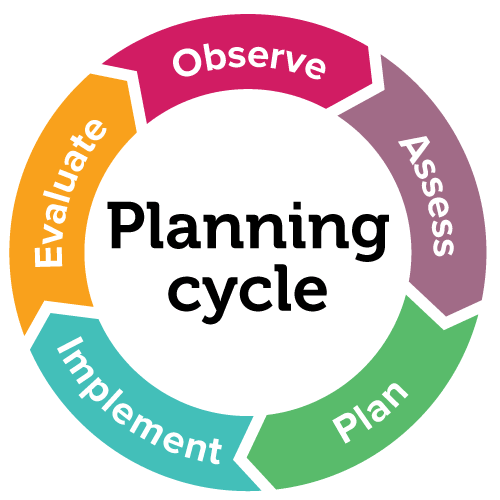
Use the EYLF Planning Cycle to model positive interactions
- Observe: the child’s pre-requisite skills and their current interactions (strengths and needs), who the child chooses to play with/alongside, and the educator/s the child is most comfortable with
- Assess: ask parents/carers and specialists about how they model interactions at home and in other environments and what works well
- Plan: individualised goals with the parents/carers and plan how to embed modelling positive interactions into learning activities based on your observations and assessment
- Implement: your plan of modelling positive interactions throughout daily activities and routines with peers and adults
- Evaluate: the impact on the child’s social-emotional and behavioural development and interactions with peers and adults
How will I know if it's working?
- Children enjoy secure and stable relationships with educators
- Children are building social and self-regulation skills through interactions with their peers and educators
- Educators embed modelling positive interactions into their daily routine
Educators establish and maintain a strong partnership with parents/carers to support consistent approaches to modelling positive interactions.
Practice toolkit
Practice implementation planner template
We know it's not always easy to keep track of what's working and what isn't. So, we've created this template for you to record and reflect on what you're doing to create more inclusive classrooms. The implementation planner contains:
- guidance around goal setting
- a reflection section (what worked, didn’t work, what to change, and next steps)
- prompting questions.
Implementation planner with examples
 Download
 Set your professional learning goal for:
Model positive interactions (Early Childhood)
Benefits of goal setting
Setting, working towards, and reflecting on goals helps you grow professionally and improve your practice. You can access AITSL learning resources for teachers to learn more about:How to set goals
The Australian Institute for Teaching and School Leadership recommends using the SMART matrix to frame your goal setting.SMART goals refers to goals that are:
- Specific
- Measurable
- Achievable
- Relevant
- Time-phased
Resources
Related Practices
Model emotional literacy (Early Childhood)
TEACHING PRACTICE
For student years
Helps students to
- feel secure and included
- identify and respond to emotions
- regulate emotion
Provide feedback on learning & behaviour (Early Childhood)
TEACHING PRACTICE
For student years
Helps students to
- stay motivated
- remain on-task for longer
- feel valued
Learning Cycle