Model emotional literacy (Early Childhood)

teaching practice
Save

For student year

Early Childhood

Helps students to

  • feel secure and included
  • identify and respond to emotions
  • regulate emotion

Helps teachers to

  • respond to children's emotions
  • support emotional development

Summary

Educators play a key role in helping young learners to develop emotional literacy, which is the ability to identify, understand, and respond to one’s emotions. Some learners, particularly neurodivergent learners, may find it challenging to recognise and understand their own emotions and the emotions of others. By building positive relationships, creating supportive environments, and explicitly teaching emotional literacy, educators can promote social emotional development and reduce unexpected behaviours. 

Emotional literacy enables all children to understand that the emotion they feel is neither good nor bad, and to understand how to process and express emotions in a healthy way. This creates empathy and kindness within your learning environment.

Australian Children’s Education and Care Quality Authority (ACECQA) National Quality Standards (NQS) related to this practice

Element 5.1.1: Positive educator to child interactions

Responsive and meaningful interactions build trusting relationships which engage and support each child to feel secure, confident and included.

Element 5.2.1: Collaborative learning

Children are supported to collaborate, learn from and help each other.

Element 5.2.2: Self-regulation 

Each child is supported to regulate their own behaviour, respond appropriately to the behaviour of others and communicate effectively to resolve conflicts

For further information, see ACEQA’s National Quality Standard page

Early Years Learning Framework (EYLF) outcomes related to this practice

Outcome 3: Children have a strong sense of wellbeing

Outcome 4: Children are confident and involved learners

For further information, see ACEQA’s Approved learning frameworks page

Join the inclusionED community

View this content in full by creating an account.

Continue

Already have an account? Log in

Preparing to teach

The ability to identify, understand, and express emotions develops over time and is a critical skill that adults can actively help foster. Plan to foster the child’s: 

  • emotional vocabulary (verbal and non-verbal)
  • identification of the full range of emotions 
  • communication of emotional experiences to others (parents/carers, peers, and educators)
  • recognition of situations that evoke these emotions
  • recognition of others’ emotions (peers and adults)

By intentionally teaching children to identify, understand and express emotions, you:

  • expose learners to a rich vocabulary for expressing feelings (verbal and/or nonverbal)
  • teach your learners about empathy for others
  • assist learners to understand ways to express their emotions. 

It works better if:

  • you use a strength-based approach to help the child identify, understand and express their emotions
  • you consider learner level of development and communication skills; emotions are abstract concepts so use visual supports (photos, pictures or video) where possible
  • you are working with parents/carers and specialists in developing goals and strategies for the child that can be used across environments and people 
  • you start by teaching universal primary emotions (e.g., happy, sad, angry) to establish a base understanding before continuing to secondary emotions (e.g., jealous, embarrassed)
  • you use different strategies to teach about emotion (e.g., visual, oral, movement)
  • strategies for managing challenging feelings are taught while the learner is calm.

It doesn’t work if:

  • strategies are taught during times of distress; we all have trouble learning when we are very stressed or upset
  • the learner has interoception needs and may struggle to recognise body clues when they are feeling emotion
  • your explanation of the feeling and associated events is not developmentally appropriate, or the learner cannot understand the emotion being taught
  • emotional dysregulation is regarded as a deficit or problem

In the classroom

How do I do it?

Throughout the day

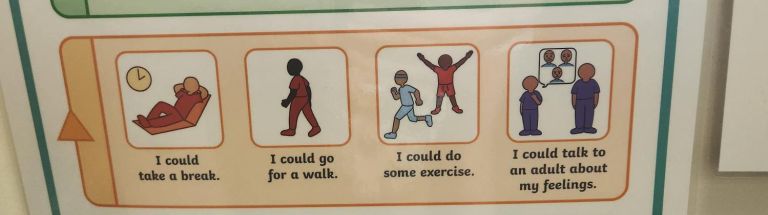
  • Model responding to, and regulating emotions (e.g., taking deep breaths when frustrated)
  • Label emotions in context, use nonverbals to show the emotion and describe how learners can express their feelings
  • Encourage learners to label their own emotions (verbal and/or nonverbal)
  • Observe peers’ emotions with the child (“Look, they’re all laughing. They look happy”)
  • Sing songs, read stories, and role-play in relation to a variety of feeling words. 

Example:

A child can’t find their favourite toy they had brought from home and is becoming upset. You can support the child by saying, “You look sad by not being able to find your toy. I feel sad too when I can’t find something I want.” This labels the emotion and models using the word 'sad' for the feeling the child is experiencing, as well as showing the child that what they are feeling is normal for the situation they’re in. You can then model some positive coping strategies for the learner, such as looking for another toy or asking other children if they have seen the toy. “It’s okay. Let’s ask if anyone has seen your car”.


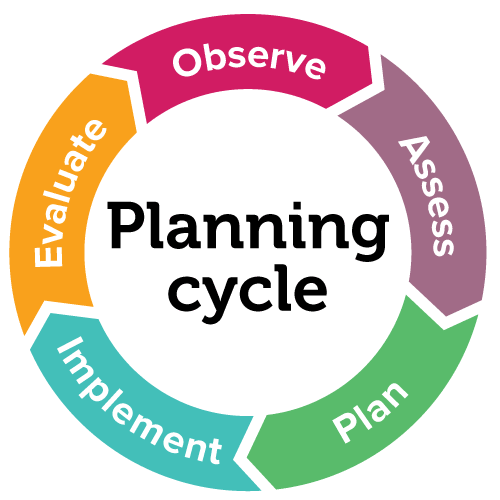
Use the EYLF Planning Cycle to model emotional literacy

  • Observe: how the child expresses and regulates their emotions 
  • Assess: ask parents/carers and any specialists about the strategies they currently use to support the child’s emotional literacy and what works well
  • Plan: how to intentionally teach children to understand and regulate their emotions throughout the day and set goals with the team of educators, parent/carer and other specialists 
  • Implement: your plan of teaching emotional literacy throughout the routines and activities of the day with all the education team
  • Evaluate: the impact of strategies on the child’s interactions, behaviour and wellbeing

How do I know if it’s working?

  • Children enjoy secure and stable relationships with educators
  • Children are building social and self-regulation skills through interactions with their peers and educators
  • Educators observe and respond to early signs of emotional dysregulation
  • Educators have a ‘toolkit’ of calm co-regulation strategies they can implement for all children
  • Educators have established and maintained a strong partnership with parents/carers to support consistent approaches to the child’s development of emotional literacy
  • Educators have the knowledge, skills and confidence to support children’s emotional regulation

Practice toolkit

Set your professional learning goal for:

Model emotional literacy (Early Childhood)
You can set and save your goal for inclusive practices using inclusionED. Saved goals will appear in your profile. Here you can access, refine and review your goal easily.

Benefits of goal setting

Setting, working towards, and reflecting on goals helps you grow professionally and improve your practice. You can access AITSL learning resources for teachers to learn more about:
How to set goals
The Australian Institute for Teaching and School Leadership recommends using the SMART matrix to frame your goal setting.

SMART goals refers to goals that are:
  • Specific
  • Measurable
  • Achievable
  • Relevant
  • Time-phased
Read more about Improving teaching practices.

Related Practices

This practice is from the core research project

On