Teach self-regulation (Early Childhood)
teaching practiceFor student year
Helps students to
- regulate their feelings
- regulate their behaviour
- feel safe, confident and included
Helps teachers to
- focus on teaching
- respond to children's emotions and behaviour
- support children's learning
Summary
Emotional and behavioural self-regulation is the ability to control or manage one’s feelings and behaviours. Self-regulation is a key part of the early years in ECEC setting. It increases as young learners understand the need to follow rules and develop their own internal value system. Self-regulation is influenced by:
- gender
- temperament
- cultural factors
- parenting styles
- life experiences.
Children take time to learn which behaviours are acceptable in which situations at home, ECEC and in the community. Learners take time to learn how to regulate feelings and behaviours by observing how people around them do this. You can assist children’s development by modelling appropriate self-regulation strategies and behaviours in the EC learning environment.
However, some learners may benefit from intentional teaching in the use of these strategies.
By building positive relationships, creating supportive environments, and explicitly teaching emotional literacy and self-regulation skills, educators can promote social emotional development and prevent challenging behaviours.
How the practice works
Watch this video to learn more about this practice.
Duration: 3:23
Australian Children’s Education and Care Quality Authority (ACECQA) National Quality Standards (NQS) related to this practice
Element 5.1.1: Positive educator to child interactions
Responsive and meaningful interactions build trusting relationships which engage and support each child to feel secure, confident and included.
Element 5.2.1: Collaborative learning
Children are supported to collaborate, learn from and help each other.
Element 5.2.2: Self-regulation
Each child is supported to regulate their own behaviour, respond appropriately to the behaviour of others and communicate effectively to resolve conflicts
For further information, see ACEQA’s National Quality Standard page
Early Years Learning Framework (EYLF) outcomes related to this practice
Outcome 3: Children have a strong sense of wellbeing
Outcome 4: Children are confident and involved learners
For further information, see ACEQA’s Approved learning frameworks page
Preparing to teach
Seek support from:
- experienced teachers
- external support professionals e.g., speech pathologist, occupational therapists, psychologist
- inclusion support professionals.
Take note of known stressors and minimise these.
Talk with parents/carers about the child’s strengths, strategies that are currently working well and their support needs.
Set the scene by identifying strategies, including:
- providing a calm environment with consistent routines
- recognising and responding to the child’s cues
- modifying the environment to decrease stress
The aim of these strategies is to:
- build on learner’s strengths
- reduce the likelihood of learners becoming overwhelmed and overstimulated
- increase on-task engagement and learning behaviours.
Plan to observe when your learners:
- can and cannot self-regulate
- what are the cues for when the child can’t self-regulate
- what helps them to self-regulate
Become aware of activities when the learner finds it difficult to self-regulate and identify a range of possible behaviours that could assist the learner to self-regulate. For example:
- take deep breaths (it can help to have learners exhale onto their hand; a long exhalation helps learners to breathe in deeply and avoid rapid, shallow intake of breath)
- take a break from the activity.
Ask your colleagues for further suggestions (especially if they have worked with your learners previously). Remember that parents/carers are also a valuable source of information about their child and should be partners in decisions about establishing goals and selecting strategies.
Plan explicit teaching of strategies and plan to teach these strategies when learners are calm and ready to learn. Develop resources needed such as visual cue cards and social stories where developmentally appropriate, and ensure these resources are accessible. Identify and plan ahead of time, multiple opportunities for learners to practise the behaviour/s including:
- role-play
- rehearsal scenarios.
These opportunities should:
- have explicit and reasonable time-limits remembering what is developmentally appropriate)
- be supported by relevant visual prompts (e.g. deep breath)
- include acknowledgement of learner attempts (e.g. specific verbal praise)
- be followed by reward time (e.g. a favoured activity)
It works better if:
- you use a strengths-based approach to support the child regulate their emotions
- if you are aware of what prompts the child’s emotional dysregulation
- behaviour/s taught has been selected for instruction because it meets learner need
- learners’ emotions vocabulary is concurrently developed (see inclusionED practice Model Emotional Literacy ).
- you are working with parents/carers and specialists in developing goals and strategies for the child that can be used across environments and people
It doesn’t work if:
- learners are taught expected behaviour/s that are too hard for them to use even with scaffolding and support (i.e., sit outside of the zone of proximal development)
- the educator response to unregulated behaviour is punitive rather than instructional.
In the classroom
Step 1. Manage the environment
Modify and manage the environment as much as possible.
Step 2. Observe behaviours
Observe when learners can and cannot self-regulate their feelings and behaviour, and take note of strengths and potential stressors. During these activities or when stressors are present, ensure the necessary proactive modifications are in place.
Learn from parents and specialists about what they know about the child’s self-regulation.
Step 3. Identify behaviours
Identify one or more behaviours (e.g., deep breaths, taking a break) which might enable students to regulate their feelings or behaviour.
Step 4. Explicit teaching
Explicitly teach learners the acceptable behaviour/s for particular situations.
Step 5. Provide opportunities
Provide multiple opportunities for students to practise the behaviour/s.
Step 6. Model behaviours
Model using the identified behaviour/s to regulate your own behaviour.
Model behaviours e.g., ‘Three big breaths’ and have students practise too.
Acknowledge and positively reinforce learner attempts.
Remember (Steps 4 – 6)
- Communicate explicitly, describing the desired behaviours.
- Communicate in a calm, predictable and positive way.
- In the event that the activity is too overwhelming for a learner, be prepared to allow him/her to take a break.
- If the activity has to be abandoned, communicate anticipation of a positive future outcome e.g., "All right, next time we’ll give it another try."
- Acknowledge and positively reinforce all learner attempts.
Record
Keep a record to help gauge effectiveness of all strategies in supporting learner progress.
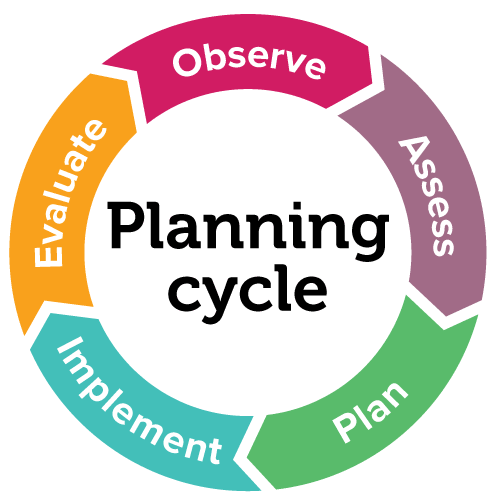
Use the EYLF Planning Cycle to teach self-regulation
- Observe: how the child expresses and regulates their emotions. Observe the ‘triggers’ of the child’s dysregulation.
- Assess: ask parents/carers and any specialists about the strategies they currently use to support the child’s self-regulation and what works well with other adults and in other environments.
- Plan: how to intentionally teach children to regulate their emotions throughout the day and set goals with the team of educators, parents/carers and other specialists
- Implement: your plan of teaching self-regulation throughout the routines and activities of the day with all the education team using developmentally appropriate strategies.
- Evaluate: the impact of strategies on the child’s interactions, behaviour and wellbeing
How do I know if it's working well?
- Children are building self-regulation skills through interactions with their peers and educators
- Educators observe and respond to early signs of emotional dysregulation
- Educators have a ‘toolkit’ of calm self-regulation strategies they can implement for all children
- Educators have established and maintained a strong partnership with parents/carers to support consistent approaches to the child’s development of self-regulations skills
- Educators have the knowledge, skills and confidence to support children’s self-regulation
Practice toolkit
Practice implementation planner template
We know it's not always easy to keep track of what's working and what isn't. So, we've created this template for you to record and reflect on what you're doing to create more inclusive classrooms. The implementation planner contains:
- guidance around goal setting
- a reflection section (what worked, didn’t work, what to change, and next steps)
- prompting questions.
Implementation planner with examples
 Download
 Set your professional learning goal for:
Teach self-regulation (Early Childhood)
Benefits of goal setting
Setting, working towards, and reflecting on goals helps you grow professionally and improve your practice. You can access AITSL learning resources for teachers to learn more about:How to set goals
The Australian Institute for Teaching and School Leadership recommends using the SMART matrix to frame your goal setting.SMART goals refers to goals that are:
- Specific
- Measurable
- Achievable
- Relevant
- Time-phased
Resources
Related Practices
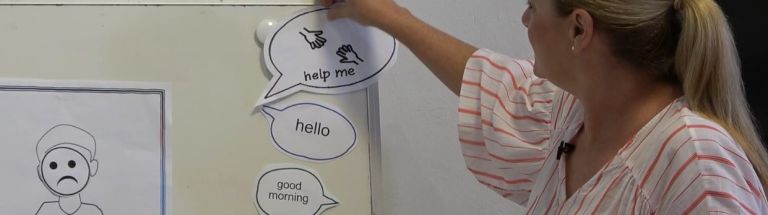
Model emotional literacy (Early Childhood)
TEACHING PRACTICE
For student years
Helps students to
- feel secure and included
- identify and respond to emotions
- regulate emotion

Model positive interactions (Early Childhood)
TEACHING PRACTICE
For student years
Helps students to
- build social-awareness
- interact with others
Learning Cycle