Support friendship skills (Early Childhood)
teaching practiceFor student year
Helps students to
- interact with peers
- participate in activities
Helps teachers to
- support social skills
Summary
The social aspect of activities, routines, and transitions is dynamic and unpredictable. Young learners often need to be flexible and respond to social situations quickly. Some young diverse learners may benefit from support to initiate, build, and maintain friendships with their peers.
Australian Children’s Education and Care Quality Authority (ACECQA) National Quality Standards (NQS) related to this practice
Element 1.1.2: Child centred
Each child’s current knowledge, strengths, ideas, culture, abilities and interests are the foundation of the program
Element 1.2.2: Responsive teaching and scaffolding
Educators respond to children’s ideas and play and extend children’s learning through open-ended questions, interactions and feedback.
Element 1.2.3: Child directed learning
Each child's agency is promoted, enabling them to make choices and decisions that influence events and their world
Element 5.2.1: Collaborative learning
Children are supported to collaborate, learn from and help each other.
For further information, see ACEQA’s National Quality Standard page
Early Years Learning Framework (EYLF) outcomes related to this practice
Outcome 2: Children are connected and contribute to their world
Outcome 4: Children are confident and involved learners
For further information, see ACEQA’s Approved learning frameworks page
Preparing to teach
Supporting learners
The ability to develop and maintain peer interactions is a skill that adults can actively help foster. Some learners may struggle to understand and fulfil the many social expectations of ECEC. They may also have very different and varied ways of coping. All of these factors can make it hard to feel like they belong and make friends.
One way to support learners is by embedding:
- systematic instruction
- multiple practice opportunities
…in play and social skills to initiate, build and maintain friendships with peers.
Plan to support social skills
Social skills training (SST) is an established and effective practice that helps learners on the autism spectrum acquire and practice effective:
- communication
- play
- social and interaction skills
- friendship skills
…and promote positive interactions with peers.
Which social skills do I target and teach?
Speak with parents/carers and colleagues including specialists such as speech pathologists, occupational therapists, specialist teachers or inclusion support professionals to plan which skills you will target and develop goals and strategies together
Observe the child’s play and social skills and learn if they have a preferred peer/friend that they interact with.
Collect data on your learner’s current level of play and social skills. Use this data to develop a learning sequence which builds these skills.
Plan to provide
- instruction on play and social skills
- role-playing opportunities
- practice opportunities
- instructional feedback
Plan to embed
Embedded instruction comprises multiple, brief teaching interactions between you and the learner throughout every activity.
Embedding the instruction within whole-of group activities and routines means that individual learners are not ‘singled out’. Instead, you establish instruction and practice that can benefit all learners. However, you may need to choose and provide personalised scaffolds and reinforcement for some learners.
Embed opportunities within routines. For example, learners have opportunities to interact with peers when having a snack, sitting on the mat for group activities or during free play.
Plan to consider learner strengths and interests
It’s helpful to consider children’s preferences when supporting the formation and maintenance of peer relationships. For example, a learner who has an interest in lions is more likely to engage with other learners around an activity incorporating lions. However, if there is an activity or item that is linked to their focused interest, then another context might be more appropriate for teaching and practising turn-taking and sharing. It can be hard to share something you love – especially when starting out.
Ensure that accessible spaces and activities are provided that encourage opportunities for children to engage with each other in play activities (e.g. a small block play table with two chairs sitting opposite each other and building mat in the middle). Children also need spaces where they can enjoy quiet time alone, so appropriate spaces need to be provided for solitary play.
It works better if:
- social skill training is personalised, targeted, and useful to individual learners
- skills are practised at home and in ECEC environments in order to foster generalisation
It doesn’t work if:
- it’s not fun and engaging
- play and social skills selected for teaching are limited to those the teacher considers important
- instruction does not provide opportunities for generalisation across people, time and settings
In the classroom
How do I do it?
Step 1. Collect data
Collect data in order to establish which play and social skills your learners already have, and the ones that they need to develop. Learn about the strengths, interests and preferences. Observe the child’s play and peer interactions and talk with parents/carers and relevant specialists.
Step 2. Develop the learning sequence
Develop a learning sequence which systematically teaches the identified play and social skills. Develop a plan with parents/carers and relevant specialists that includes specific goals, strategies and evaluation.
Step 3. Instruct and practice
Provide instruction and opportunities for practice including role-play and rehearsal in relation to these identified skills across activities, routines, and transitions. Include peers in the interactions.
Step 4. Review progress
Check if the frequency of learner interactions has increased. Review the opportunities provided for learners to learn and practice friendship skills.
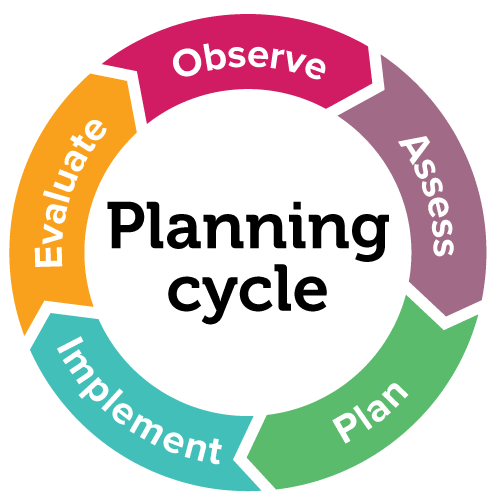
Use the EYLF Planning Cycle to support friendship skills
- Observe: the child’s play and social skills and their current peer interactions (strengths and needs). Observe who the child currently chooses to play with or alongside. Observe their interests and preferences.
- Assess: ask parents/carers and specialists about the child’s social skills at home (e.g. with siblings) and in other environments where the child lives, learn and plays (e.g. playground). Learn from others about effective strategies that are currently being implemented to support peer interactions.
- Plan: individualised goals with the parents/carers and plan how to embed peer interactions into learning activities based on your observations and assessment.
- Implement: your plan throughout daily activities and routines with peers and adults.
- Evaluate: the impact on the child’s social-emotional development and interactions with peers and adults.
How will I know if it's working?
- The learner will be building play and social skills through interactions with peers and educators
- Educators will embed intentional teaching of play and social skills into their daily routine
- Educators will establish and maintain a strong partnership with parents/carers to support consistent goals and strategies
Practice toolkit
Practice implementation planner template
We know it's not always easy to keep track of what's working and what isn't. So, we've created this template for you to record and reflect on what you're doing to create more inclusive classrooms. The implementation planner contains:
- guidance around goal setting
- a reflection section (what worked, didn’t work, what to change, and next steps)
- prompting questions.
Implementation planner with examples
 Download
 Set your professional learning goal for:
Support friendship skills (Early Childhood)
Benefits of goal setting
Setting, working towards, and reflecting on goals helps you grow professionally and improve your practice. You can access AITSL learning resources for teachers to learn more about:How to set goals
The Australian Institute for Teaching and School Leadership recommends using the SMART matrix to frame your goal setting.SMART goals refers to goals that are:
- Specific
- Measurable
- Achievable
- Relevant
- Time-phased
Resources
Related Practices
Model emotional literacy (Early Childhood)
TEACHING PRACTICE
For student years
Helps students to
- feel secure and included
- identify and respond to emotions
- regulate emotion
Teach social problem solving (Early Childhood)
TEACHING PRACTICE
For student years
Helps students to
- solve social problems
- become independent
Learning Cycle