Embed opportunities for choice making (Early Childhood)
teaching practiceFor student year
Helps students to
- make decisions
- build independence
Helps teachers to
- engage learners
- encourage independence
Summary
Embedding opportunities for choice in learning and play activities throughout the day can be helpful adjustments for young learners who find decision-making stressful or who use unexpected behaviours to assert control within their environment.
Giving learners a degree of autonomy through choices may reduce conflict and unexpected behaviours by helping them feel they have some control or say in what happens in their day.
How the practice works
Watch this video to learn more.
Duration 3:34
Australian Children’s Education and Care Quality Authority (ACECQA) National Quality Standards (NQS) related to this practice
Element 1.1.2: Child centred
Each child’s current knowledge, strengths, ideas, culture, abilities and interests are the foundation of the program
Element 1.2.3: Child directed learning
Each child's agency is promoted, enabling them to make choices and decisions that influence events and their world
For further information, see ACEQA’s National Quality Standard page
Early Years Learning Framework (EYLF) outcomes related to this practice
Outcome3: Children have a strong sense of wellbeing
Outcome 4: Children are confident and involved learners
For further information, see ACEQA’s Approved learning frameworks page
Preparing to teach
Why is this important?
Practicing basic decision making can encourage agency, independence and confidence in young children.
What do I need to consider?
Identify multiple opportunities for learner choice-making in your activity, session or lesson plan:
- within choices – how to complete a particular activity
- when choices – the timing of activities, e.g., when to take a break or whether they spend 5 or 10 minutes on a preferred task
- where choices – the location of activities e.g. outside, under a tree or inside
- whom choices – which children work together on an activity; whether they work in a pair or by themselves
It can be easier to choose between a small number of options rather than having to find one from a seemingly endless array of potential options.
Choose what the learner/s will choose between. Offer a maximum of two or three possible choices depending on their development. It is important that you provide choices that are equitable and task suitable.
As the educator, you need to be comfortable with children choosing whatever choices you provide. By only offering choices that you are comfortable with, you are managing the program but also promoting children’s agency and independence.
Examples
- When it’s time for outdoor play and children are required to wear hats. If the child typically rejects wearing a hat, offer a choice of two options “It’s outside time. We all wear hats. Do you want your blue hat or red hat”?
- During indoor play, the child roams the room having difficulty choosing and settling at an activity. The educator takes the child to the daily visual schedule board and offers a choice of three activities. “It’s play time. Would you like to start with the blocks, puzzles or painting?” The child takes the photo of the blocks. “Great, blocks first. When you have finished, come back and you can choose your next activity.”
It works better if…
- you present learners with the number of options than they can manage developmentally (e.g. a choice between two options)
- you give learners as many opportunities to make choices as possible
- the learners are given ample time to process questions and respond
- you use visual supports wherever possible (e.g., when giving a choice between wearing a red hat or blue hat, show the hats at the time of decision making).
It doesn’t work if…
- there are too many choices offered at the same time (e.g. a choice between four activities)
- a choice is only given sporadically
- choices aren't task or developmentally appropriate
In the classroom
How do I do it?
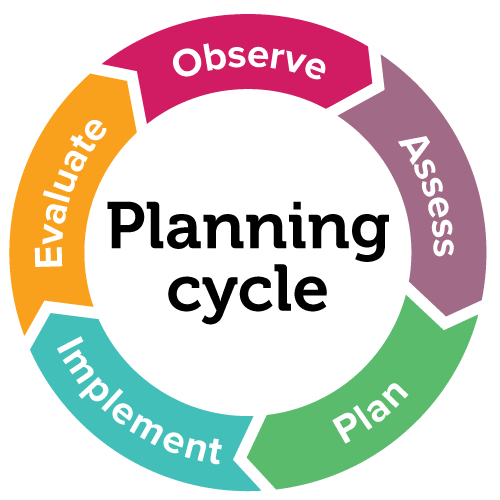
Use the EYLF Planning Cycle to support children’s choice making
- Observe: what choices the child likes to make in the day, what choices are offered in the program and how the child behaves when choices are offered (or not)
- Assess: whether more choice would increase the child’s agency and positive behaviour
- Plan: when, where, with whom, and how to offer the child choices and develop an individualised plan that includes gaols established with parents/carers and other specialists that may be involved
- Implement: choice making throughout daily activities and routines
- Evaluate: the impact of choice making opportunities on the child’s autonomy, behaviour and independence
How will I know if it’s working?
- Choice making is embedded in ECEC learning routines and activities
- Children are developing independence and autonomy
- Unexpected behaviours have decreased as children effectively communicate their needs and wants
- The educator, parents/carers and other specialists are developing goals together and communicating about choice making strategies
Practice toolkit
Practice implementation planner template
We know it's not always easy to keep track of what's working and what isn't. So, we've created this template for you to record and reflect on what you're doing to create more inclusive classrooms. The implementation planner contains:
- guidance around goal setting
- a reflection section (what worked, didn’t work, what to change, and next steps)
- prompting questions.
Implementation planner with examples
 Download
 Set your professional learning goal for:
Embed opportunities for choice making (Early Childhood)
Benefits of goal setting
Setting, working towards, and reflecting on goals helps you grow professionally and improve your practice. You can access AITSL learning resources for teachers to learn more about:How to set goals
The Australian Institute for Teaching and School Leadership recommends using the SMART matrix to frame your goal setting.SMART goals refers to goals that are:
- Specific
- Measurable
- Achievable
- Relevant
- Time-phased
Related Practices

Harness learner interests (Early Childhood)
TEACHING PRACTICE
For student years
Helps students to
- be more engaged
- be motivated to learn and participate
- increase learning opportunities

Teach social problem solving (Early Childhood)
TEACHING PRACTICE
For student years
Helps students to
- solve social problems
- become independent


Learning Cycle