Prepare children for transitions (Early Childhood)
teaching practiceFor student year
Helps students to
- manage transitions
- decrease anxiety during transitions
- increase engagement
Helps teachers to
- prepare for daily transitions
- communicate change to learners
- transition learners effectively
Summary
For the primary and secondary school version of this practice, go to:
Prepare students for transitions
Most young children, especially neurodivergent children, thrive in structured and consistent learning environments. You can provide structure and predictability by carefully preparing learners for transitioning between:
- activities
- learning and play spaces and
- environments
Transition between activities, learning spaces, and indoor and outdoor environments may require learners to stop doing something they like, which can be difficult. Alerting learners to the impending change can make transitions easier. Learners rely on communication, self-regulation, and social skills during transitions, and this should be taken into consideration when planning.
By intentionally teaching and consistently using transition routines, you can:
- support learners in your group to understand what is happening next
- reduce anxiety related to unexpected transitions
- increase engagement and
- reduce emotional dysregulation and behavioural concerns.
How this practice works
Watch this video to learn more about transitions.
(Duration 2:40)
Australian Children’s Education and Care Quality Authority (ACECQA) National Quality Standards (NQS) related to this practice
Element 1.1.3: Program learning opportunities
All aspects of the program, including routines, are organised in ways that maximise opportunities for each child’s learning
Element 6.2.1: Transitions
Continuity of learning and transitions for each child are supported by sharing information and clarifying responsibilities
For further information, see ACEQA’s National Quality Standard page
Early Years Learning Framework (EYLF) outcomes related to this practice
Outcome 3: Children have a strong sense of wellbeing
Outcome 4: Children are confident and involved learners
For further information, see ACEQA’s Approved learning frameworks page
Preparing to teach
What is a transition?
A transition is the movement from one activity, learning or play space, or environment to another. Transition routines are an established series of steps that guide learners through change. Some learners may have difficulty with transitions.
Use these steps to help you prepare your transition plan:
- Review your daily routine to identify regular transitions that occur throughout a session, day, and week. For example, this can be from outside to inside play or from free-play to mat-time to snack time.
- Design a transition routine appropriate for these transitions.
- Establish a series of steps associated with the completion of that movement. For example, you can provide a 5-minute and then a 3-minute warning before learners need to switch tasks using a visual or auditory cue. You can use countdown timers for the whole group, or some learners may need a personal visual cue such as a photo or music cue.
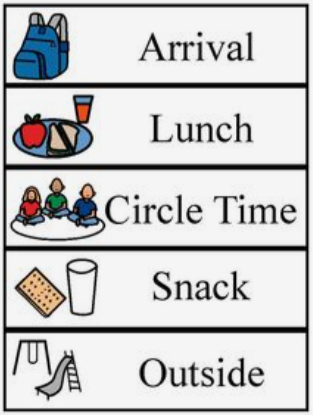
- Prepare/create supporting materials. This might look like a photo with the current activity with a cross through it and the second photo of the next activity, or a photo schedule board that the child can use to remove the picture of the activity that is finished and be shown what’s happening next. The child’s specialists (speech pathologist, occupational therapist) can help with these materials.
- Ensure that supporting materials are ready and accessible for learners and the materials can be used by all children
Remember to consider the type of activity and the learner's reaction to it:
- If the child is engaged in a favoured activity the transition to something different will be harder, especially if the transition has not been communicated effectively. For example, a child who loves to draw may become frustrated when they haven't been able to finish drawing before being transitioned to the next activity.
- Moving to a less desired activity will make the transition to the activity harder, which may result in emotional dysregulation. For example, a child who doesn’t like sitting in close proximity to others and prefers not to sit together at mat time might protest about the transition to mat time activities.
Easing learners into transition routines can reduce these behavioural concerns.
It works better if you:
- provide children with prompts before a transition
- ensure there is enough time for children to calmly transition from one activity or environment to another
- use visual/auditory prompts to support the transition routine
- use the same steps in as many of the transition routines as possible, e.g., ’First pack away, then sit on the mat’, or ‘When the music plays, it’s pack away time’.
- provide positive reinforcement for learners for following the transition routine
It doesn’t work if you:
- don't use the transition routine consistently
- constantly change daily routines, or
- change the routine without warning
In the classroom
How do I do it?
Steps to applying a transition routine
- Ensure supporting materials are ready and in place
- Clearly and explicitly explain the transition e.g., “In 5 minutes it’s time to stop playing and help pack away. You’ll hear the music play when it’s time to help”.
- Consistently use these transition routines and any associated visual or auditory supports.
- Prepare children for changes in their transition routine with enough time for them to adjust and manage the transition calmly.
- Prepare children as early as possible for new, one-off, or unexpected transitions.
Help children to know what to expect
- Talk through and show what is going to happen in the transition – with individual children and/or the whole group
- Practice the transition beforehand.
- Use visual supports to help children follow a transition routine.
If a familiar transition routine must change, use visual supports to forewarn children such as flexible/impromptu symbols or cue cards. For example, an ‘X’ can be placed over a step in the visual timetable to show that it will not be occurring.
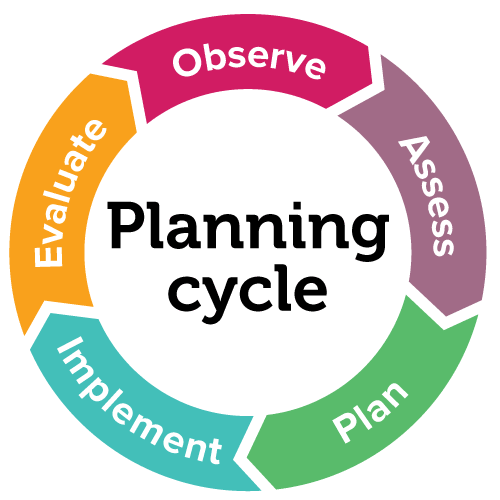
Use the EYLF Planning Cycle to prepare children for transitions
- Observe: routines and activities where the child experiences difficulty with transitions and when they are managing well. Note the strategies that are currently supporting the child with transitions
- Assess: ask parents/carers and any specialists about what works best in supporting transitions at home and other environments where the child lives, learns and plays
- Plan: how to embed transition support into the daily routine and establish individualised goals with the parent/carer and other specialists that may be involved
- Implement: your plan of using intentional teaching strategies to support the child’s smooth transitions
- Evaluate: the impact of transition strategies on the child’s learning, emotional regulation and behaviour informing future strategies
How will I know if it's working?
- Children’s emotional regulation at times of transition increases
- Children can transition from one activity, learning space or environment more independently
- Children’s anxiety around transitioning decreases
- Educators can communicate effectively with parents and specialists to develop goals and ensure consistency of transition approaches
- Educators have the knowledge, skills and confidence to support successful transitions
Practice toolkit
Practice implementation planner template
We know it's not always easy to keep track of what's working and what isn't. So, we've created this template for you to record and reflect on what you're doing to create more inclusive classrooms. The implementation planner contains:
- guidance around goal setting
- a reflection section (what worked, didn’t work, what to change, and next steps)
- prompting questions.
Implementation planner with examples
 Download
 Set your professional learning goal for:
Prepare children for transitions (Early Childhood)
Benefits of goal setting
Setting, working towards, and reflecting on goals helps you grow professionally and improve your practice. You can access AITSL learning resources for teachers to learn more about:How to set goals
The Australian Institute for Teaching and School Leadership recommends using the SMART matrix to frame your goal setting.SMART goals refers to goals that are:
- Specific
- Measurable
- Achievable
- Relevant
- Time-phased
Related Practices
Teach self-regulation (Early Childhood)
TEACHING PRACTICE
For student years
Helps students to
- regulate their feelings
- regulate their behaviour
- feel safe, confident and included
Use visual schedules
TEACHING PRACTICE
For student years
Helps students to
- transition smoothly
- understand expectations
- learn new concepts
Learning Cycle