For student year
Helps students to
- feel less anxious
- transition smoothly
- know what is coming next
Helps teachers to
- set expectations
- support transitions
- reduce verbal prompts
Summary
Some learners find it challenging to carry out unfamiliar or continuously changing instructions. They need clear predictable routines to help them understand what they need to do. Knowing what will happen, when, and in what order can help reduce anxiety related to unexpected circumstances.
To clarify:
- A routine is a sequence of actions that make up a regular activity.
- Routines are typically explicitly taught using schedules at the beginning of the year.
- A schedule shows the sequence of activities that make up a session, the day or the week.
- Visual schedules are a visual display of a sequence of activities.
- Visual routines are a pictorial display of the actions required to complete a routine task, such as unpacking a bag or packing up classroom equipment.
Using visual schedules and routines helps your learners to know what is coming next, and the sequence of actions required to adequately complete a task.
This practice focuses on why consistency improves the efficacy of visual schedules and routines. It is to be used in conjunction with the Use visual schedules practice.
How this practice works
Watch this video for more information.
Duration: 2:46
Australian Children’s Education and Care Quality Authority (ACECQA) National Quality Standards (NQS) related to this practice
Element 1.1.3: Program learning opportunities
All aspects of the program, including routines, are organised in ways that maximise opportunities for each child’s learning.
For further information, see ACEQA’s National Quality Standard page
Early Years Learning Framework outcomes related to this practice
Outcome 1: Children have a strong sense of identity
Outcome 4: Children are confident and involved learners
For further information, see ACEQA’s Approved learning frameworks page
Preparing to teach
How does it help?
Routines in the learning environment are predictable and consist of frequently repeated sequences of activities that remain the same even when the content or the instructional format changes. Providing age-appropriate visual schedules (in the form of pictures for young learners) at learner eye-level can show the sequence of upcoming activities or events. This practice can be embedded as a part of the daily morning routine so children know what to expect during the day. Schedules indicate both what is the same and what is different in the current or upcoming day, and as such can help children cope with change and transitions.
Consistent routines enable you to:
- enhance structure
- provide predictability
- increase learners’ ability to focus
- increase learners’ ability to stay on-task
Routines can include:
- packing their bag
- eating a meal
- packing up the room
- packing up and putting away play materials
- cleaning up before home time
- packing up and putting away outdoor sporting equipment
In order to develop a specific routine, you’ll need to consider all the actions required to complete a specific task and the order that they must be completed. For example, a routine for after an art and craft lesson might be:
- Make sure child’s name is on their painting
- Put painting in the airing trays
- Wash the paintbrushes
- Empty the water containers
- Clean the art desks
- Take off the art apron for cleaning or drying
- Wash hands with soap and water
Have a think about which activities would benefit most from consistent and explicit routines to ensure the smooth operation of learning.
How do routines and schedules support inclusive classrooms?
Visual schedules and routines are helpful for all children, regardless of need or diagnosis.
Think about how much you rely on diaries or planners to organise your day and how knowing what comes next makes you feel comforted. It’s the same for your learners.
Using these tools consistently provides predictability, and gives learners boundaries and expectations to uphold in the classroom.
Why is consistency so important?
Consistency is key to establishing a new behaviour or expectation in the classroom. Attempting a new strategy without sticking to it means you will have difficulty determining if it has been successful or not. The length of time for a ‘trial’ is also dependent on your learners’ abilities.
The balance, order, and tempo of activities/events should be considered when developing class and/or individual schedules. Consider the learner’s attention span and when they are most alert.
When preparing a visual schedule or routine, think about the information that must be included, and how you can make it accessible. Ensure all learners can see the visual schedule and turn their attention it at regular intervals.
| Information | Accessibility |
|
|
Consider where it will be placed in the room and how you will use it.
It works better if:
- the schedule, including upcoming changes, is available at the beginning of the day and at regular intervals
- attention is drawn to what is staying the same as well as what is different
- learners are positively reinforced for following a routine and for accepting change
- the independent use of schedules is encouraged by fading cues over time
- some learners are provided with both a whole-class schedule and an individual schedule i.e., individual schedules move with learners across settings and activities
- schedules are adjusted to be less demanding if a learner is stressed or just having a bad day.
It doesn’t work if:
- the form of representation used is inconsistent with the learning needs of the learner, e.g., words are used instead of pictures
- the schedule is long and complex or changes often
- the visual schedule is not age appropriate
- the learners don’t understand the purpose of the schedule or routine
- it is not updated
- it is not referred to frequently
In the classroom
How do I do it?
- Show learners the visual schedule or routine at the beginning of each day or before the routine activity is due to occur (such as preparing for a craft lesson).
- Display the visual schedule or routine in a prominent position - ensure that it is easy to see by providing empty space around the schedule. Schedules that are surrounded by lots of visual materials are more difficult to focus on and notice in the room.
- If possible, show and forewarn learners about any unexpected changes at the beginning of the day.
- Consistently refer to the visual schedule or routine, particularly to support the transition to the next activity/task.
- Encourage and monitor the use of the visual schedules.
- Reinforce those learners who follow the schedule or routine.
- Show changes to the schedule when required – if forewarning isn’t possible, be sure to introduce the change via the schedule in the moment.
- Remove/cross off schedule items as activities are finished to provide activity closure and show progress through the day’s plan.
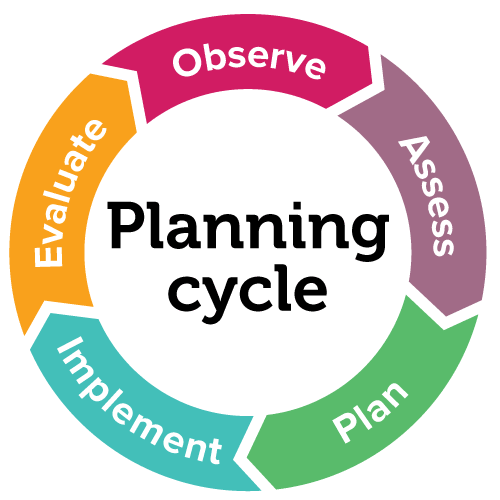
Use the EYLF Planning Cycle to consistently use routines and schedules
- Observe: what routines the child has difficulty with and at what point it becomes difficult
- Assess: ask parents/carers about any routines used at home and what language or visual supports are used
- Plan: map out every stage of a specific frequent routine and develop visual supports to accompany the routine
- Implement: your plan by explicitly explaining the routine and referring to visual supports
- Evaluate: any changes to the child’s competency in completing frequent tasks or activities using the routine
How will I know if it's working?
- Children know expectations during activity transitions and activity completion
- Children refer to the visual supports or visual schedules
- Children seem less anxious or surprised about changes in activity
- Children seem less anxious about what will happen next
- Educators find activities and lessons flow much easier
Why is this going to be effective?
When learners know what is coming next and when, they can better prepare themselves to complete a current activity and move onto a new activity.
Using routines and schedules consistently may result in a decrease in off-task behaviour and an increase in independence.
Using visual schedules and routines in a consistent way also improves the likelihood that these behaviours are adopted and supports children to be aware of and understand expectations.
Practice toolkit
Set your professional learning goal for:
Consistently use routines and schedules (Early Childhood)
Benefits of goal setting
Setting, working towards, and reflecting on goals helps you grow professionally and improve your practice. You can access AITSL learning resources for teachers to learn more about:How to set goals
The Australian Institute for Teaching and School Leadership recommends using the SMART matrix to frame your goal setting.SMART goals refers to goals that are:
- Specific
- Measurable
- Achievable
- Relevant
- Time-phased
Related Practices
Prepare children for transitions (Early Childhood)
TEACHING PRACTICE
For student years
Helps students to
- manage transitions
- decrease anxiety during transitions
- increase engagement

Use visual schedules
TEACHING PRACTICE
For student years
Helps students to
- transition smoothly
- understand expectations
- learn new concepts
Use visual supports to increase understanding (Early Childhood)
TEACHING PRACTICE
For student years
Helps students to
- learn new concepts
- follow lengthy instructions
- increase communication skills
This practice is from the core research project
Learning Cycle