For student year
Helps students to
- be supported across settings
- have their voice heard
Helps teachers to
- build partnerships with families
- understand family's goals for their child
- understand the learner
Summary
When an effective partnership has been cultivated between parents/carers and educators, it strengthens everyone’s ability to support the child’s learning, development and wellbeing. Educators can foster respectful partnerships through timely, open, consistent, empathetic and culturally responsive communication.
Communication between home and the learning environment involves a learner’s parents/carers and educators sharing information on a regular basis to provide consistency across both settings to support their success. Wherever possible, communication should include the child’s voice so they can be part of making decisions that are important to them. Communication should support collaborative goal setting and problem solving.
When a collaborative relationship has developed, educators can share information with parents/carers about learner progress towards their goals, strategies that are working well, and areas that would benefit from further discussion. Similarly, parents/carers can provide valuable information about the child’s functioning in other environments such as at home, sport and leisure activities, and in the community.
How this practice works
Watch this video to learn more.
Duration: 3:26
Australian Children’s Education and Care Quality Authority (ACECQA) National Quality Standards (NQS) related to this practice
Element 6.1: Supportive relationships with families
Respectful relationships with families are developed and maintained and families are supported in their parenting role
Element 6.2: Collaborative partnerships
Collaborative partnerships enhance children’s inclusion, learning and wellbeing
For further information, see ACEQA’s National Quality Standard page
Early Years Learning Framework (EYLF) outcomes related to this practice
Outcome 1: Children have a strong sense of identity
Outcome 2: Children are connected and contribute to their world
Outcome 3: Children have a strong sense of wellbeing
Outcome 4: Children are confident and involved learners
For further information, see ACEQA’s Approved learning frameworks page
Preparing to teach
Why communication between settings is important
Effective communication between settings can enhance the transfer of the learner’s skills and knowledge across environments. It enhances consistency of strategies between ECEC and home and supports smooth transitions (e.g. ECEC to school).
Example:
The educator observes that the child is finding the transition from home to ECEC more difficult over the last week. The child needs prompts to settle at an activity and is sometimes teary and withdrawn. The parent and educator had already developed an approach to their communication that included a request from the parent that any changes in behaviour be raised early. They preferred text messages so they could use the translation function to their first language. The parent had also observed more withdrawn behaviour over the past week and attributed it to recent changes within the family’s morning routine. Together, the educator and parents developed some simple strategies they could both implement to support the child’s engagement and social-emotional wellbeing and agreed to text each other the following week to check-in on how things were going.
It works better if the educator:
- uses clear and accessible language, avoiding education jargon
- establishes whether an interpreter is required
- finds a common ground on the type and extent of home–school communication
- offers a range of communication channels to parents/carers, e.g. meetings, phone calls, emails
- acknowledges and values the perspectives of parents/carers
- ensures that communication is constructive and positive.
It doesn't work if:
- a trusting and respectful relationship isn’t established and maintained
- communication is one-way
- communication between settings is mainly negative (e.g. meetings are requested when there’s a problem rather than regular meetings that include success)
- meetings are held without a clear agenda and a focus on the child goals.
In the classroom
How do I do it?
Meet with parents/carers at the start of the year
When you first meet with parents/carers, begin to develop a collaborative relationship by agreeing on how you want to communicate together in the future. Establish how often you want to meet and what time suits everyone. Make sure there are ways to include the child’s voice wherever possible.
You can:
- Discuss parents/carers preferred method of communication and offer a range of channels, e.g.:
- a communication book
- regular meetings
- an email address
- phone calls or text.
- Discuss the frequency of meetings and establish a time that suits everyone
- Establish if the parent/s carers need an interpreter and information translated in their community language
- Ensure parents/carers have adequate instructions and resources if a communication channel is technology-based.
- Inform parents/carers about all opportunities for formal meetings and engagements.
Implement and review
- Be proactive about developing effective communication and a collaborative relationship with parents/carers.
- Review communication with parents/carers on a regular basis. Identify what’s working well, any difficulties with communication, and revise accordingly.
- Regularly share information about learners with parents/carers, so they know about their child’s achievements at ECEC. Ask parents/carers about their child’s participation and learning at home and other environments
- Consider what information from parents/carers might assist planning, e.g. strengths, special interests that may help to motivate a learner, routines and support with transitions. Review two-way communication throughout the year. Discuss successful communication strategies during hand-over to other education and support staff.
Practice effective communication skills
- Practice active listening
- Demonstrate empathy and respect
- Get feedback from colleagues about whether you are being clear and concise
- Don’t use professional jargon
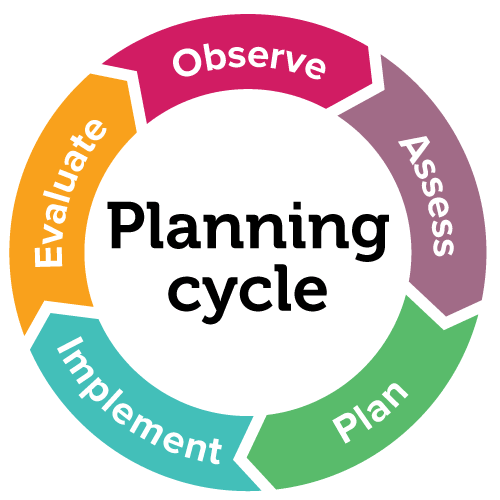
Use the EYLF Planning Cycle to communicate and collaborate with parents/carers effectively
- Observe: how parents/carers choose to communicate with you and the other educators and what communication strategies are working well
- Assess: ask parents/carers about the ways they would like to communicate
- Plan: with the education team on changes to your practice that could improve partnerships with parents/carers in your ECEC service
- Implement: your plan for individual parent/carers and for all families within your service
- Evaluate: the impact on parent/carer engagement with your ECEC service
How will I know if it’s working?
- Educators feel motivated to work collaboratively with all families
- Educators have established effective communication channels with the child’s parent/carer
- Educators and parents/carers communicate about the child’s strengths and achievements as well as areas of need
- Parents/ carers are more engaged in the ECEC service
- Parent/carers report feeling like they are connected and belong to the ECEC service
- Educators and parents/carers consider how the child’s voice can be heard
Practice toolkit
Set your professional learning goal for:
Engage families with effective communication (Early Childhood)
Benefits of goal setting
Setting, working towards, and reflecting on goals helps you grow professionally and improve your practice. You can access AITSL learning resources for teachers to learn more about:How to set goals
The Australian Institute for Teaching and School Leadership recommends using the SMART matrix to frame your goal setting.SMART goals refers to goals that are:
- Specific
- Measurable
- Achievable
- Relevant
- Time-phased
Related Practices
Provide feedback on learning & behaviour (Early Childhood)
TEACHING PRACTICE
For student years
Helps students to
- stay motivated
- remain on-task for longer
- feel valued
Share information through home–school communication
TEACHING PRACTICE
For student years
Helps students to
- be supported across settings

This practice is from the core research project
Learning Cycle